
Luxating Patella in Dogs: Understanding the Condition and Why Early Management Matters

Have you ever noticed your dog suddenly skipping a few steps, lifting one hind leg briefly, then carrying on as though nothing happened?
This occasional skipping or hopping can be a sign of luxating patella (LP), a common orthopaedic condition affecting dogs, particularly smaller breeds.
While some dogs experience pain or difficulty walking, others may show little to no obvious symptoms. However, even when a dog appears comfortable, the condition can affect how their knee functions and how they move.
So, what exactly is luxating patella, and why is it worth addressing before problems arise?
Let's Start with the Anatomy of the Knee (Stifle)

The patella, commonly known as the kneecap, is a small bone located at the front of the knee joint (also called the stifle).
In a healthy knee, the kneecap sits within a groove at the end of the thigh bone (femur), known as the trochlear groove. As your dog bends and straightens their knee, the kneecap glides smoothly within this groove.
What Causes Luxating Patella?
Luxating patella occurs when the kneecap slips out of its normal groove, either towards the inside or outside of the knee.
This is often associated with differences in the shape or alignment of the bones that make up a dog's knee joint. The surrounding muscles and soft tissues can also influence how the kneecap moves and stays in place.
LP is more common in certain breeds, particularly smaller dogs, partly due to inherited traits. Several factors can affect how well the kneecap stays in its groove:
Shallow groove: The groove where the kneecap sits may be too shallow to keep it securely in place.
Bone alignment: The thigh bone (femur) or shin bone (tibia) may be angled or rotated, causing the kneecap to move towards one side instead of tracking smoothly within its groove.
Muscle and soft tissue balance: The muscles and soft tissues around the knee help guide and support kneecap movement. Differences in their strength, coordination or tension may affect how smoothly the kneecap tracks.
Less commonly, luxating patella can also develop following an injury to the knee, such as a fall or trauma that damages its supporting structures.
Types of Patellar Luxation

Patellar luxation can be classified into three types, depending on the direction in which the kneecap slips out of its groove.
1. Medial Patellar Luxation (MPL)
The kneecap slips towards the inside of the knee. This is the most common type of patellar luxation, particularly in smaller breeds such as Pomeranians, Chihuahuas and Toy Poodles.
2. Lateral Patellar Luxation (LPL)
The kneecap slips towards the outside of the knee. This is less common than MPL and is seen more frequently in larger breeds.
3. Bidirectional Patellar Luxation (BPL)
The kneecap can slip towards both the inside and outside of the same knee. This is a relatively uncommon form of patellar luxation.
Understanding the Grades of Luxating Patella
Luxating patella is classified into four grades based on how easily the kneecap slips out of position and whether it can return to its normal groove.

Grade 1: The kneecap normally stays in place but can be manually pushed out of its groove. It returns on its own when released.
Grade 2: The kneecap can slip out during movement but may return on its own or when the knee is repositioned.
Grade 3: The kneecap remains displaced most of the time. It can be manually repositioned back into the groove but slips out again.
Grade 4: The kneecap is permanently displaced and cannot be manually returned to its normal position.
Does a Higher Grade Always Mean More Pain?
Not necessarily!
Although higher grades are generally associated with more significant changes to the knee, they don't always mean more pain.
For example, dogs with Grade 4 LP may have adapted to walking with their kneecap permanently out of place, while dogs with lower grades may experience intermittent discomfort when the kneecap slips in and out of its groove.
The grade tells us how unstable or displaced the kneecap is, but not necessarily how much pain your dog experiences or how well they move.
This is why assessing your dog's movement and physical function is just as important as knowing their grade.
Can Luxating Patella Get Worse Over Time?
Not every dog with luxating patella will progress to a higher grade. Some remain stable for years, while others develop increasing instability or secondary joint problems.
Over time, abnormal kneecap movement and changes in how the affected limb is used may contribute to several problems.
1. Joint Wear and Osteoarthritis
Abnormal kneecap movement can increase stress on the joint surfaces and contribute to cartilage damage. Over time, these changes may lead to inflammation, osteoarthritis, joint stiffness and discomfort.
Dogs with luxating patella may also develop other knee problems, including cranial cruciate ligament injuries.
2. Muscle Weakness and Reduced Muscle Mass
When a knee becomes unstable or uncomfortable, dogs may begin relying less on the affected hind limb.
Over time, reduced use of that leg can contribute to muscle weakness and loss of muscle mass.
3. Compensatory Movement Patterns
To accommodate an unstable knee, dogs may redistribute their weight, change their walking pattern or adopt different positions when sitting and standing.
These changes may place additional demands on other muscles and joints.
4. Reduced Mobility and Function
As discomfort or joint changes develop, some dogs may become less willing to jump, climb stairs, go for longer walks or participate in activities they previously enjoyed.
Most importantly, progression isn't always about moving from one grade to another. Even when the grade remains unchanged, secondary changes such as muscle weakness or osteoarthritis may develop.
Early Signs of Luxating Patella
The signs of luxating patella can vary considerably. Some dogs display obvious limping, while others show only occasional or subtle changes.
Signs to look out for include:
Skipping or hopping: Briefly lifting a hind leg during walking or running before returning to a normal gait.
Intermittent limping: Occasionally favouring one hind limb, particularly during or after activity.
Changes in sitting posture: Consistently sitting with one leg positioned differently or shifting weight towards one side.
Difficulty with certain movements: Hesitating when jumping, climbing stairs or rising from sitting.
Changes in activity levels: Reduced enthusiasm for walks, play or activities they previously enjoyed.
Reduced muscle mass: One hind limb appearing smaller or less muscular than the other.
These signs can also be associated with other orthopaedic conditions, so veterinary assessment is important.
Some dogs with mild luxating patella may not display any noticeable signs at all.
How Is Luxating Patella Diagnosed?
Luxating patella is usually diagnosed through a veterinary orthopaedic examination.
Your veterinarian will assess how easily the kneecap slips out of its groove, whether it returns to its normal position and any associated discomfort or joint abnormalities. This helps determine the grade of luxation.
Additional imaging, such as X-rays, may be recommended to assess bone alignment, joint changes or other underlying conditions.
Where Does Physiotherapy Come In?
While a veterinary examination helps identify and grade the luxation, a physiotherapy assessment focuses on how the condition affects your dog's movement and physical function.
This may include assessing:
Muscle strength and symmetry of the hind limbs.
Weight distribution and ability to bear weight through each leg.
Posture and movement patterns during standing, sitting and walking.
Joint mobility, balance and coordination.
Together, these findings help us understand how your dog is functioning beyond their diagnosed grade and guide an individualised physiotherapy programme.
Treatment and Management of Luxating Patella
Treatment depends on several factors, including the grade of luxation, presence of pain or limping, joint stability, functional limitations and your dog's overall health.
Management may involve conservative treatment, surgical intervention or a combination of both, depending on your dog's needs.

Conservative Management
Conservative management is often considered for dogs with mild luxation and minimal or no symptoms, particularly Grade 1 and selected Grade 2 cases.
The aim is to support joint health, maintain muscle strength and help dogs move comfortably.
Alongside maintaining a healthy weight and managing joint discomfort when needed, physiotherapy can help improve muscle strength, weight-bearing ability, coordination and movement patterns.
While physiotherapy cannot correct the underlying structural abnormalities responsible for LP, it can help address associated functional limitations.
Surgical Management
Surgery may be recommended for dogs with more severe luxations, persistent or worsening lameness, or significant difficulties with movement.
Surgical procedures aim to correct the underlying mechanical problems contributing to patellar luxation. Depending on the dog's anatomy, this may involve deepening the groove, realigning the kneecap's supporting structures, balancing surrounding soft tissues or correcting bone deformities.
Postoperative physiotherapy can help dogs gradually regain muscle strength, joint mobility and functional movement during recovery.
Why Is Early Management Important?
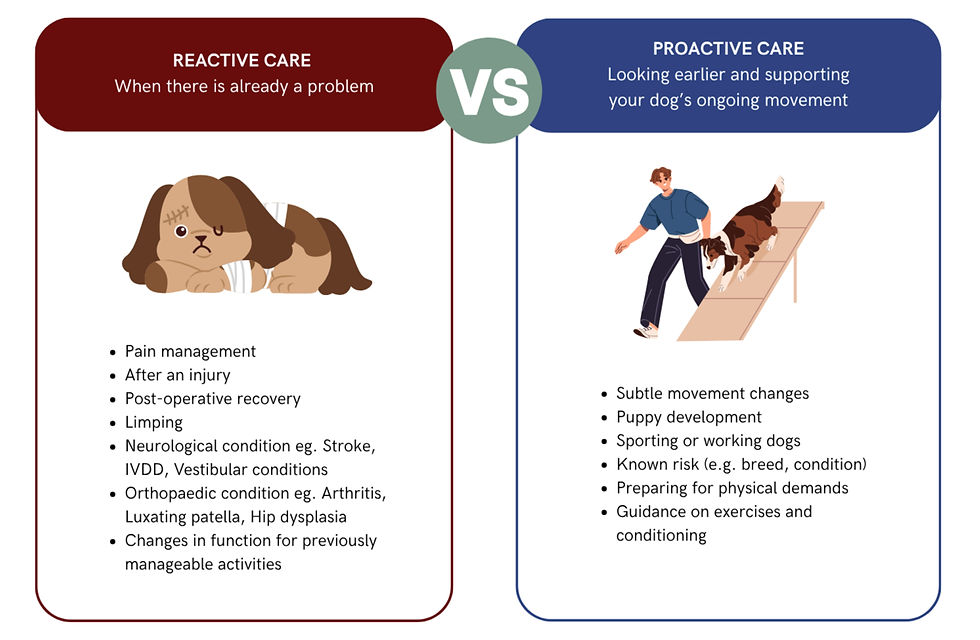
A common misconception is that dogs with luxating patella only need treatment when they begin limping or showing signs of pain.
However, the absence of pain does not necessarily mean the knee is functioning normally.
Dogs are remarkably adaptable. They may continue walking, running and playing despite subtle changes in how they use their limbs.
For example, a dog with mild luxating patella may appear to walk normally but consistently shift more weight onto the unaffected hind limb.
Over time, these changes may contribute to muscle weakness, compensatory movement patterns and additional demands on other parts of the body. By the time obvious pain or limping develops, some secondary changes may already be present.
This is why early assessment and management can be valuable, even when your dog seems comfortable. Rather than waiting for symptoms to develop, physiotherapy provides an opportunity to:
Identify early changes: Detect subtle muscle weakness, weight-bearing differences or altered movement patterns.
Maintain strength and control: Support muscle function and coordinated movement across the hind limbs.
Address compensations: Encourage more balanced movement and reduce unnecessary reliance on other limbs.
Monitor changes over time: Establish a baseline and identify changes in strength, mobility or function.
Although early rehabilitation does not guarantee that the luxation will remain at the same grade or prevent the development of osteoarthritis. Appropriate strengthening, movement training and ongoing monitoring can help address functional limitations and support your dog's ability to remain active and comfortable.
The goal isn't simply to treat pain when it appears, but to support good movement and function while your dog is still doing well.
The Takeaway: Don't Wait for a Limp
A diagnosis of luxating patella does not necessarily mean your dog will experience severe pain, lose mobility or require surgery. Many dogs with mild luxations continue to live active, comfortable lives.
However, even when your dog appears to be moving normally, subtle changes in muscle strength, weight distribution and movement patterns may already be present.
Recognising these changes early and introducing appropriate management can help support their long-term mobility and function.
Managing luxating patella isn't just about treating pain. It's about supporting movement before limitations develop.
References
1. Di Dona, F., Della Valle, G., & Fatone, G. (2018). Patellar luxation in dogs. Veterinary Medicine: Research and Reports, 9, 23–32. https://pmc.ncbi.nlm.nih.gov/articles/PMC6055913/
2. Son, J. Y., et al. (2026). Translational rehabilitation strategies for canine medial patellar luxation: Insights from human patellofemoral pain syndrome. Frontiers in Veterinary Science, 13. https://doi.org/10.3389/fvets.2026.1885078
3. American College of Veterinary Surgeons (ACVS). (n.d.). Patellar luxations. https://www.acvs.org/small-animal/patellar-luxations/

Comments