
Reactive vs Proactive Care: When Does Your Dog Actually Need Physio?

“My dog runs a little funny… but otherwise, they’re doing fine.”
They still run, play, and may even participate in sports like agility. So, does it really need looking at?
Think about yourself: if a certain movement repeatedly felt uncomfortable, or you noticed discomfort in your leg every time you ran, would you ignore it just because you could still keep going?
In human healthcare, physiotherapy is a familiar part of recovery after injury, surgery or changes in mobility. Canine physiotherapy has a similar role, and it doesn’t always have to begin only after something has gone wrong.
Generally, we can think about physiotherapy in two ways: reactive care and proactive care.
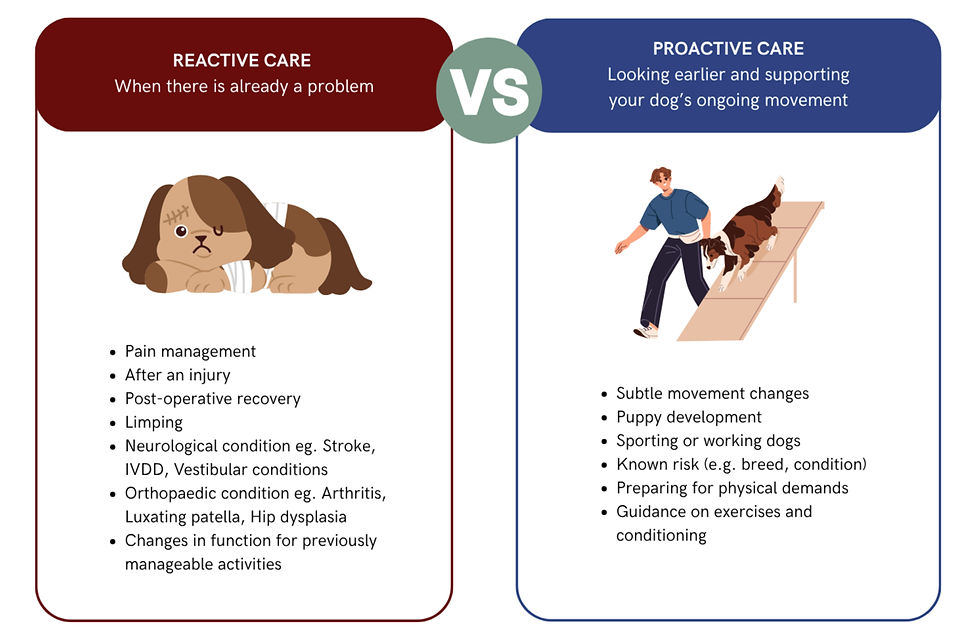
1. Reactive care: when there is already a problem
This is probably the most familiar reason for a dog to see a physiotherapist.
Your dog may be:
recovering from surgery or injury
diagnosed with an orthopaedic condition (e.g. luxating patella) or a neurological condition (e.g. IVDD)
showing weakness or reduced mobility
experiencing pain or limping
struggling with activities they could previously manage
Depending on your dog's condition and goals, rehabilitation may focus on:
managing pain
restoring movement
rebuilding strength
improving overall function for daily life
Physiotherapy is commonly used alongside veterinary treatment for a range of orthopaedic and neurological conditions, with research supporting benefits in areas such as post-operative recovery, mobility and function.
Condition | What physiotherapy may help with | What the evidence shows |
After TPLO surgery | Rebuilding muscle, improving knee movement and function | • Better thigh muscle mass • Improved knee range of motion • Structured rehabilitation may provide more benefit than walking alone |
Osteoarthritis | Maintaining mobility, strength and comfort as part of long-term management | • Commonly included in multimodal OA management (Evidence for individual techniques varies) |
IVDD / spinal surgery | Supporting mobility, strength, coordination and return to function | • Commonly part of post-operative recovery after IVDD surgery • Some studies report improved functional outcomes • Programmes should be individualised |
Reactive care is important, and in many cases, it is exactly when physiotherapy is needed.
The difference is that care begins after the problem has already started affecting the dog.
2. Proactive care: does something need to be serious first?
Not always.
Sometimes owners notice small things such as:
“My puppy always sits with one leg out.”
“My dog runs a little funny.”
“They move differently when they are tired.”
“They have hip dysplasia on X-ray, but they seem completely fine.”
“They are still doing agility, so surely it cannot be that serious?”
And sometimes, there genuinely is nothing concerning.
Dogs come in different shapes and sizes, and not every unusual posture or movement means that something is wrong.
But there is a difference between:
“My dog can still do it!” and “How is my dog doing it?”
Dogs are incredibly adaptable. As quadrupeds, they can redistribute weight and rely more on other parts of the body when needed. So they may still be able to run, jump, play or complete an agility course even if they are moving a little differently.
This is where physiotherapy can help. As movement specialists, physiotherapists assess the dog as a whole, including:
posture
gait at different speeds
joint mobility
muscle condition
strength
balance and coordination
functional movement
We may be able to identify subtle changes in how a dog is loading or using their body that are not obvious during everyday activity. These changes may not be causing a problem now, but repeated compensation can place greater demand on certain muscles or joints over time.
The aim is not to find something wrong with every dog. It is to understand whether the way they are moving is normal for them, worth monitoring, or something that may benefit from intervention.
Who may benefit from proactive care?
Proactive care may be relevant for different dogs depending on their age, lifestyle, physical demands and any concerns already identified.
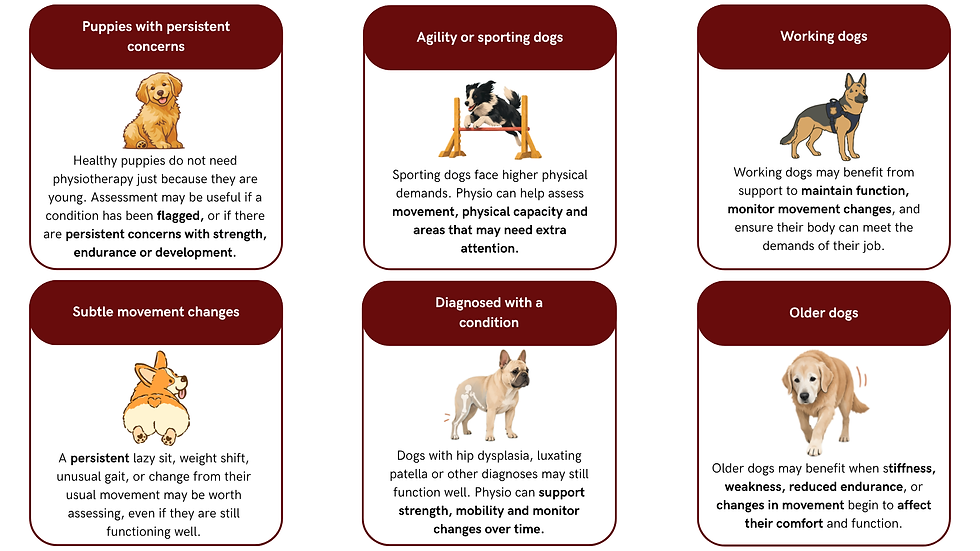
Proactive care is about understanding the dog in front of us and what they need to move well. It is not about trying to prevent every possible injury, but about supporting their comfort, function and quality of life based on their age, lifestyle and individual needs.
3. Working towards independence
Physiotherapy should always be working towards a goal, and as your dog reaches that goal, treatment can often become less frequent.
From there, the focus shifts towards maintaining progress through selected exercises, activity recommendations and everyday activity.
This does not necessarily mean doing a full rehabilitation programme forever. For many dogs, it is more about staying active through their usual walks, play or sport, and keeping a few useful exercises as part of their routine.
Much like human physiotherapy, the aim is to give you the tools to manage well outside the clinic and return for review when needed.
For many dogs, discharge is a positive outcome. The goal is not lifelong rehabilitation, but helping them move well and maintain that progress in everyday life..
So, when does your dog need physiotherapy?
Sometimes the answer is clear: after injury, surgery, pain or loss of function.
Other times, it may be for something more subtle, such as a change in movement, a known condition, or the demands of sport.
Seeing a physiotherapist does not automatically mean something is wrong or that treatment will continue forever. Sometimes we rehabilitate, sometimes we strengthen, sometimes we monitor, and sometimes we simply reassure.
The goal is helping your dog move as well as they can for the life they want to live.
References
Hodgson, M. M., Bevan, J. M., Evans, R. B., & Johnson, T. I. (2017). Influence of in-house rehabilitation on the postoperative outcome of dogs with intervertebral disk herniation. Veterinary Surgery, 46(4), 566–573. https://doi.org/10.1111/vsu.12635 PubMed
Millis, D. L., & Ciuperca, I. A. (2015). Evidence for canine rehabilitation and physical therapy. Veterinary Clinics of North America: Small Animal Practice, 45(1), 1–27. https://doi.org/10.1016/j.cvsm.2014.09.001 PubMed
Monk, M. L., Preston, C. A., & McGowan, C. M. (2006). Effects of early intensive postoperative physiotherapy on limb function after tibial plateau leveling osteotomy in dogs with deficiency of the cranial cruciate ligament. American Journal of Veterinary Research, 67(3), 529–536. https://doi.org/10.2460/ajvr.67.3.529 PubMed
Montalbano, C. (2022). Canine comprehensive mobility assessment. Veterinary Clinics of North America: Small Animal Practice, 52(4), 841–856.This is the one supporting your section on assessing posture, gait, muscle condition, joint mobility and functional movement.
Pye, C., Clark, N., Bruniges, N., Peffers, M., & Comerford, E. (2024). Current evidence for non-pharmaceutical, non-surgical treatments of canine osteoarthritis. Journal of Small Animal Practice, 65(1), 3–23. https://doi.org/10.1111/jsap.13670 PubMed
Tomlinson, J., & Nelson, M. (2022). Conditioning dogs for an active lifestyle. Veterinary Clinics of North America: Small Animal Practice, 52(4), 1043–1058. https://doi.org/10.1016/j.cvsm.2022.03.008


Comments